Last verified
How to read a Colorado water decree
A decree record answers five questions: how senior, how much, from where, for what, and is it real yet. Everything else is detail.
This page walks through an actual record — an 1875 ditch on the Little Thompson River — so that when you pull your own, you know which numbers matter and which are decoration. DWR · WDID 0400588 · verified Jul. 2026
The record we are reading
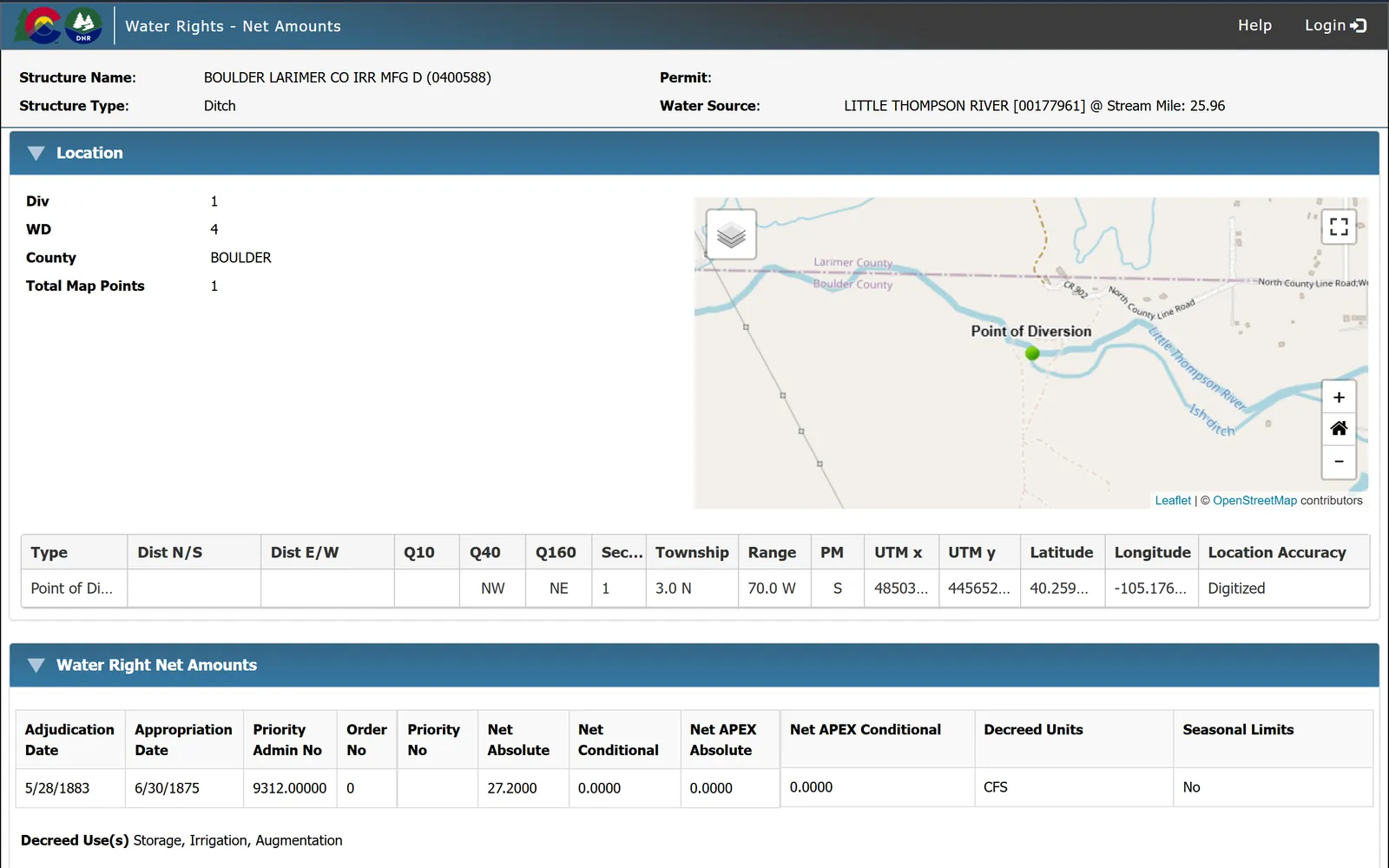
Search a WDID in DWR's Water Rights — Net Amounts tool and you get one row per decreed amount. Here is the first of eight records on WDID 0400588:
| Field | Value | What it tells you |
|---|---|---|
| Structure name | BOULDER LARIMER CO IRR MFG D | Boulder and Larimer County Irrigating and Manufacturing Ditch — records abbreviate brutally |
| Structure type | Ditch | A direct-flow diversion, not storage |
| Water source | LITTLE THOMPSON RIVER | The stream the right is administered against |
| Division / district | 1 / 4 | Division 1, South Platte — so Division 1 water court |
| Appropriation date | 1875-06-30 | Seniority, in principle |
| Adjudication date | 1883-05-28 | When the court confirmed it — eight years later |
| Administration number | 9312.0 | Seniority, as actually administered |
| Net absolute | 27.2 | Water already put to beneficial use |
| Net conditional | 0.0 | Nothing merely planned |
| Decreed units | C | cfs — a rate, not a volume |
| Decreed uses | 01A | Use codes, one character per use: storage (0), irrigation (1), augmentation (A) |
| Case numbers | 95CW0238, 05/28/1883 | The court history, including a modern case |
1Start with the priority date — then distrust it
The appropriation date is when the right was earned; the adjudication date is when a court confirmed it. Here they are eight years apart, which is normal for a 19th-century ditch.
The appropriation date usually governs, but not always, so do not stop here.
2Read the administration number, which is the real answer
The administration number is how the division engineer actually ranks rights in the field, and it is arithmetic you can check yourself: it is the number of days from December 31, 1849 to the appropriation date.
This record says 9312.0. Count 9,312 days forward from December 31, 1849 and you land exactly on June 30, 1875. A second record on the same ditch, appropriated May 20, 1877, carries 10002.0 — again exact. Lower number, more senior.
3Separate absolute from conditional
netAbsolute is water actually diverted and used. netConditional is a place in line for something not yet built. Our record is 27.2 absolute and 0.0 conditional — a real, working right.
A listing advertising "50 cfs" that turns out to be conditional is advertising a plan, with a diligence clock running against it. See absolute versus conditional.
4Check the units, because cfs and acre-feet are different animals
C means cubic feet per second — a rate. One cfs is roughly 449 gallons per minute, and running continuously for a day it delivers just under two acre-feet. A means acre-feet, a volume, which is how storage rights are measured.
A ditch decreed at 27.2 cfs may divert that when in priority and when the water is physically there. It is a ceiling, not an entitlement.
5Decode the use, and check it against your plans
Decreed uses appear as codes, one character per use. 01A here reads as storage, irrigation and augmentation, which is how DWR's own record page spells it out. The use is a legal limit, not a description: an irrigation right cannot lawfully serve houses or fill a commercial pond without a change of water right.
This is the field that most often breaks a purchase. Write down what you intend to do with the water and check it against this code before anything else.
6Follow the case numbers
associatedCaseNumbers here reads 95CW0238, 05/28/1883 — an 1883 original adjudication and a 1995 water court case. Modern case numbers follow the pattern year + CW + number, and a right with several of them has been changed, augmented, or defended over the years.
Those later cases usually matter more than the original decree, because they carry the conditions the right operates under today. Pull them from the water court for the division.
7Read every record on the structure, not just the first
This WDID carries eight net amount records with different dates, amounts and administration numbers. A structure is not a right — it is a place where several rights are diverted.
If someone tells you "the ditch has an 1875 right," ask which of the eight, for how much, and with what administration number.
What a record still will not tell you
- Who owns it. Ownership comes from recorded deeds and ditch company share books.
- Whether it gets water. That depends on the call regime on the reach — ask the division engineer's office.
- Historical consumptive use. The transferable quantity is an engineering conclusion, not a field in a database. See what rights are worth.
- Conditions from later decrees. Those are in the court file.
Next in this sequence is searching well permits, which is a different database with different rules. If you came here from a purchase, buying water rights puts this reading into the diligence sequence, and the lookup hub maps the other databases.
Common questions
What is an administration number on a Colorado water right?
It is the appropriation date expressed as a count of days since December 31, 1849, used to rank rights in the field — a lower number is more senior. A right appropriated on June 30, 1875 carries administration number 9312.0, which is exactly 9,312 days after December 31, 1849. Rights adjudicated in a later proceeding than they were appropriated carry a compound number with a decimal, reflecting the postponement rule in C.R.S. § 37-92-306.
What does "C" mean on a Colorado water right?
Cubic feet per second — the decreed unit for a direct-flow right, which is a rate rather than a volume. One cfs is about 449 gallons per minute. Storage rights are decreed in acre-feet and show the unit "A".
What is the difference between the appropriation date and the adjudication date?
The appropriation date is when water was first put to beneficial use and generally determines seniority. The adjudication date is when a water court confirmed the right. Nineteenth-century rights routinely show gaps of years or decades between the two.
Why does one structure have several water rights?
Because a structure is a physical diversion point, and multiple decreed amounts with different priority dates can be diverted through it. A single ditch commonly carries rights appropriated decades apart, each administered separately.
What do Colorado water court case numbers look like?
Modern cases follow the pattern year, then CW, then a number — for example 95CW0238 for a 1995 case. Nineteenth-century adjudications appear as dates. A right with several associated case numbers has been changed or defended since its original decree, and those later decrees carry the conditions it operates under now.